My Grammar Cheat Sheets
Tenses
Simple Tenses
-
Simple Present Tense: untuk menyatakan fakta, kebiasaan dan kejadian yang berulang-ulang saat ini.
My brother and I always leave for school at 6 o’clock in the morning.
Adikku dan aku selalu berangkat ke sekolah jam 6 pagi.
-
Simple Past Tense: untuk menyatakan fakta, kebiasaan dan kejadian pada masa lampau sampai ke detail spesifik waktu.
Soekarno declared the independence of Indonesia in August 17th 1945.
Soekarno mendeklarasikan kemerdekaan Indonesia pada 17 Agustus 1945.
-
Simple Future Tense: untuk menyatakan kejadian dan rencana di masa depan.
We will move to Palembang next month.
Kami akan pindah ke Palembang bulan depan.
Continuous Tenses
Continuous tenses digunakan untuk menyatakan kejadian yang sedang berlangsung, hanya masanya saja yang berbeda.
-
Present Continuous Tense: sedang berlangsung pada saat dinyatakan.
My classmates are talking about their plan after graduation.
Teman-teman sekelasku sedang membicarakan rencana mereka setelah kelulusan.
-
Past Continuous Tense: menyatakan saat sedang berlangsungnya suatu kejadian pada masa lampau.
When my father came from work yesterday, my mother was watching her favorite TV show.
Ketika Ayahku pulang kerja kemarin, Ibuku sedang melihat acara TV kesukaannya.
-
Future Continuous Tense: menyatakan suatu kejadian yang (mungkin) sedang berlangsung di masa depan
At 4 p.m. tomorrow, David will be playing football with his friends.
Besok pukul 4 sore, David pasti sedang bermain sepak bola dengan teman-temannya.
Perfect Tenses
Prefect tenses digunakan untuk menyatakan kejadian yang sudah sepenuhnya terjadi. Yang membedakan hanya kapan terjadinya.
-
Present Perfect Tense: sudah terjadi saat dinyatakan tanpa penekanan ke waktu.
We have had our lunch.
Kami sudah makan siang.
-
Past Perfect Tense: sudah terjadi pada masa lampau.
When I picked up John last night, he had already finished his dinner.
Ketika aku menjemput John semalam, dia sudah selesei makan malam.
-
Future Perfect Tense: sudah terjadi di masa depan.
The traffic jam is really horrible. We must be late. By the time we get to the concert, Raisa will have performed already.
Kemacetan ini benar-benar kacau. Kita pasti terlambat. Saat kita tiba di konser nanti, Raisa pasti sudah tampil.
Perfect Continuous Tenses
Perfect continuous tenses digunakan untuk menyatakan kejadian yang sudah terjadi tetapi masih berlangsung. Berbeda dengan perfect tenses, perfect continuous tenses digunakan untuk lebih menekankan durasi suatu kejadian.
-
Present Perfect Continuous Tense: sudah terjadi dan masih berlangsung pada saat dinyatakan.
Sara has been working on her homework for two hours. She doesn’t seem to finish soon.
Sara sudah mengerjakan PR-nya selama 2 jam. Sepertinya dia tidak akan selesai segera.
-
Past Perfect Continuous Tense: sudah terjadi dan masih berlangsung pada masa lampau.
James had been studying for over two hours when we knocked on his door last night.
James telah belajar selama lebih dari dua jam ketika kami mengetuk pintunya semalam.
-
Future Perfect Continuous Tense: sudah terjadi dan masih berlangsung di masa depan.
By the end of this year, I will have been studying in the language faculty of Universitas Indonesia. I know it’s a tough dream but I’m sure I can do it.
Menjelang akhir tahun ini, aku pasti sudah belajar di fakultas bahasa Universitas Indonesia. Aku tahu itu impian yang sulit tapi aku yakin aku bisa.
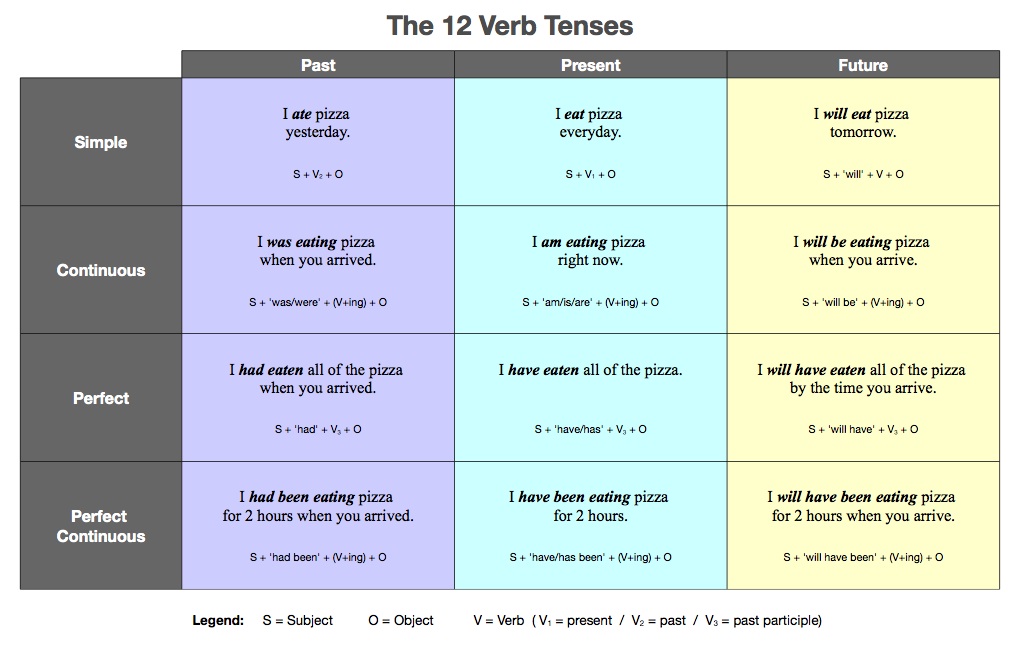 12 Verb Tenses Explained
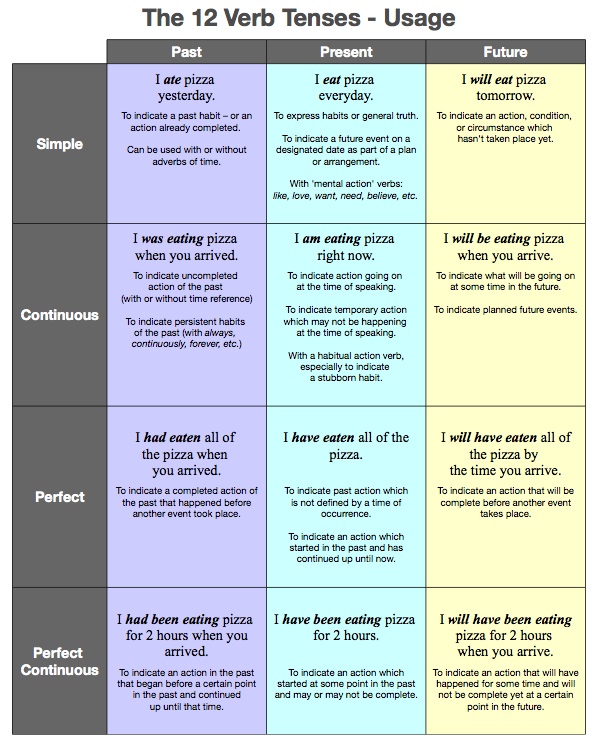 12 Verb Tenses Usage
Versus
“Rather than” vs “Instead of”
Rather than - shows preference. This expression is generally used in parallel structures. e.g - with two nouns, adjectives, adverbs, infinitives or -ing forms.
- We ought to invest in machinery rather than buildings.
- I prefer starting early rather than leaving things to the last minute.
When the main clause has a to - infinitive, rather than is usually followed by an infinitive without to or -ing form.
- I decided to write rather than phone/phoning.
Instead of - suggests that one person, thing or action replaces another. Instead is not used alone as a preposition, we use the two words instead of. Instead of is not usually followed by an infinitive.
- I’ll have tea instead of coffee, please.
- I stayed in bed all day instead of going to work.
- Amit was invited to the reception, but he was ill, so Akash went instead of him.
Note:
Instead (without of) is an adverb. It begins or ends a clause usually.
- She didn’t go to Greece after all. Instead, she went to America.
Have vs Has
| Basis for Comparison | Have | Has |
|---|---|---|
| Pronoun | I, We, You, They, These, Those | He, She, It, This, That |
| Nouns | Used with plural nouns. | Used with singular nouns. |
| Pronunciation | hav | haz |
| Meaning | Have is the base form of verb, that means to possess, hold or own something. | Has is a form of have, that denotes what people hold or possess. |
| You have good sense of humor. | She has good market knowledge. | |
| Examples | I have to submit the project by tomorrow, any how. | Akira has submitted the college project today. |
| Have you entered your personal details in the railway reservation form? | Has she confirmed the railway reservation status? |
Reference
- Smart Book of Grammar, Agus Priyanto, ISBN-13 978-602-6992-94-9
- https://www.usingenglish.com/forum/threads/121917-quot-Rather-than-quot-vs-quot-Instead-of-quot
- https://keydifferences.com/difference-between-has-and-have.html
- https://www.easypacelearning.com/all-lessons/grammar/1198-12-verb-tenses-table-learning-english-grammar-tenses